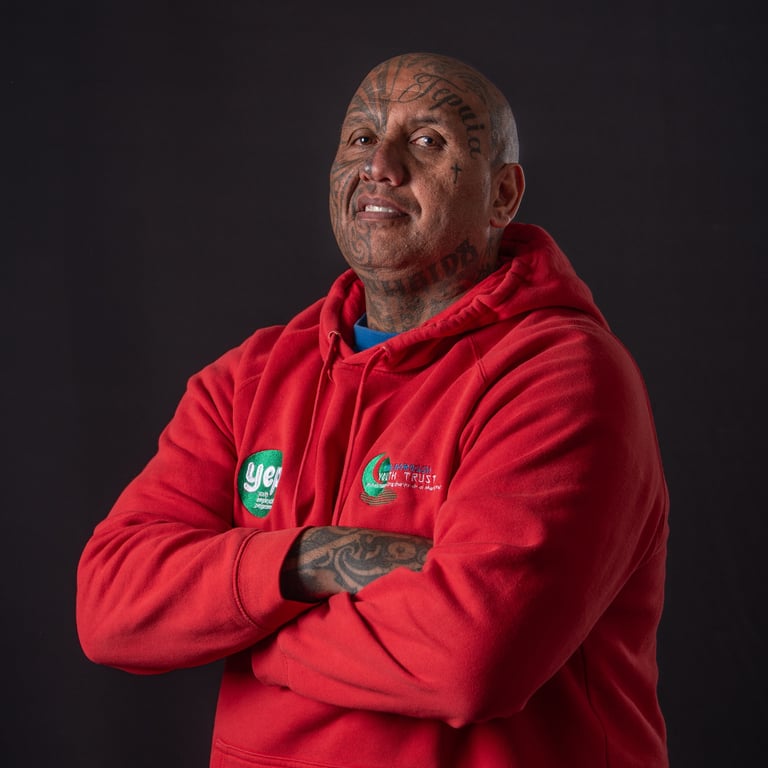
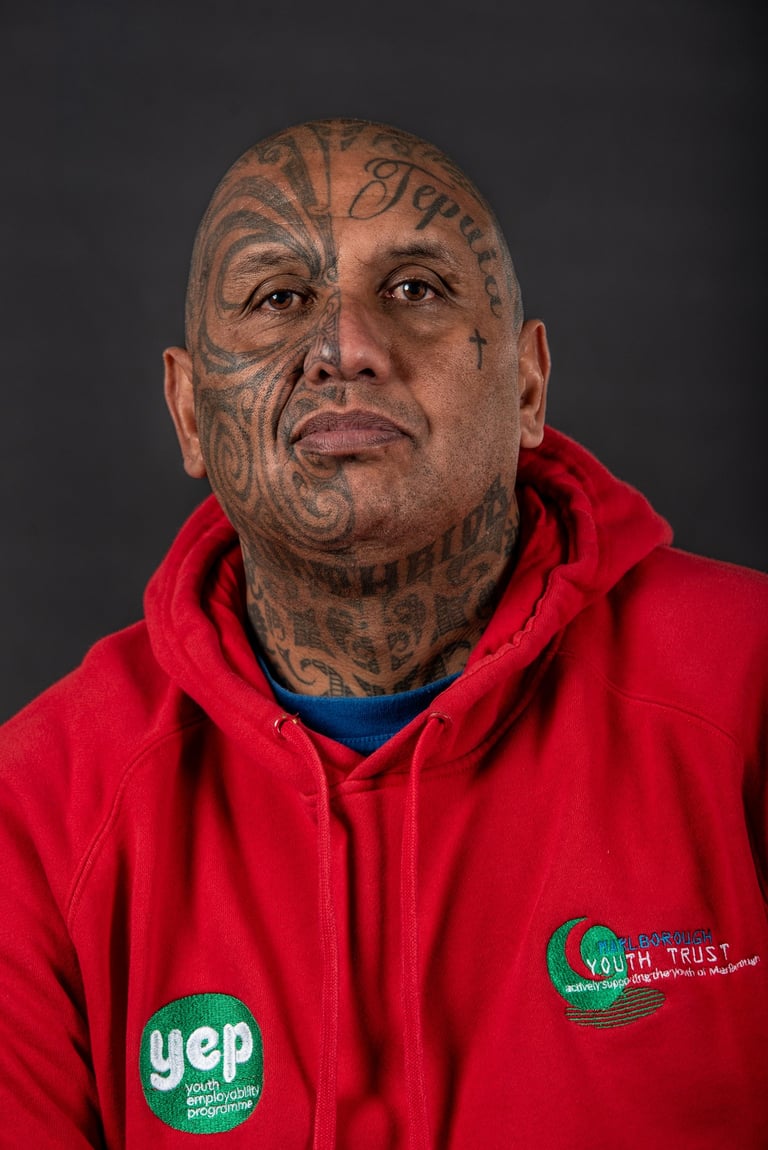
Lee Tepuia
The man proving that your past doesn't have to define your future.
The Man in the Mirror
The blows landing on the heavy bag echoed around the room.
Lee stopped.
He turned towards the mirror and looked behind him.
No one.
For years he'd surrounded himself with people.
Brotherhood. Loyalty. Strength.
But in that moment, there was only one person standing there.
Himself.
"No one's going to help me," he thought. "I've got to do it myself."
It wasn't the beginning of Lee's story.
But it was the moment everything began to change.
The man sitting opposite me in the studio isn't quite who I expected.
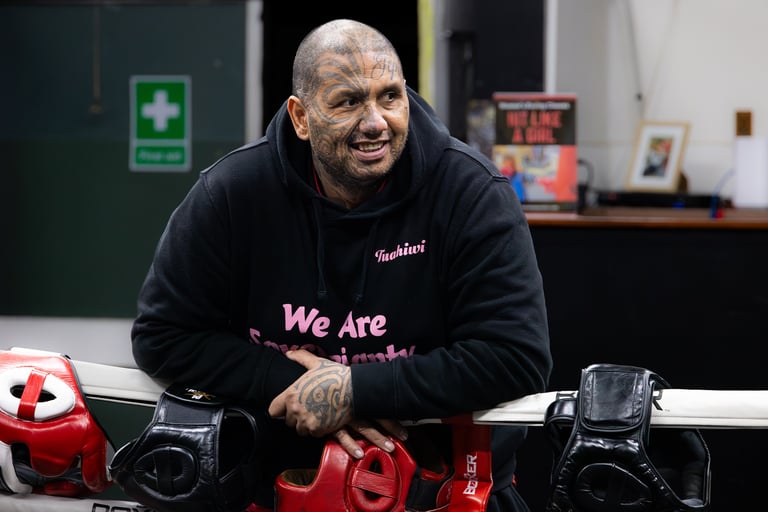
Yes, the tattoos are there. They tell part of his story before a word is spoken. But it's his eyes that hold my attention. They're calm, thoughtful and kind – the eyes of someone who has found peace after spending years searching for it.
Before we even sit down to talk, Lee Tepuia pulls on a red Marlborough Youth Trust hoodie.
People know him for Box On Boxing, he tells me.
Today, he'd like people to also know him for the work he does at the Youth Trust.
Lee was seven years old when he was sexually abused by a trusted family friend.
For years he carried the blame himself.
"I blamed myself."
The hurt became anger, and the anger shaped much of his childhood. He ran away from home, got into trouble and never really felt as though he belonged.
Eventually that search for belonging took him to Australia.
There, the Rebels Motorcycle Club became the family he connected with. He talks about the brotherhood they shared and the sense of belonging he found there. For someone who had spent much of his childhood searching for somewhere to fit, it mattered.
But life wasn't finished testing him.
In 2017, Lee and his family were deported to New Zealand because of his association with the Rebels. Although he had no criminal record, Australia deemed him to be of bad character.
Returning to Blenheim meant bringing his wife and children to a country that wasn't really home to them. It also meant driving past streets and places that triggered memories he'd spent years trying to bury.
His mother's health was failing.
Depression tightened its grip.
Counselling had already begun, but the road ahead still seemed overwhelming.
One of the first people Lee contacted after returning home was Glen, the employer he'd worked for before leaving for Australia. He asked if there was any work. There was.
It was one of the first stepping stones as he began rebuilding his life, and today Lee still speaks of Glen with deep gratitude.
Then came the phone call that changed everything.
His former partner rang to tell him one of their daughters was in hospital.
As he stood by her bedside, she looked at him and quietly told him she didn't want to be here anymore.
Lee remembers thinking exactly the same thing.
"I don't want to be here either."
For the first time, he saw his own pain reflected in someone he loved.
Not long afterwards, his mother said something that has never left him.
"Son... I think it's time to think about you. Think about your family."
He knew exactly what she meant.
He had to leave the gang.
Not because someone demanded it.
Because he finally wanted something different for himself.
This is when he tells me the story of the mirror.
He'd been punching the heavy bag, trying to work through everything that had built up inside him. When he stopped, he looked into the mirror.
Then he looked behind him.
No one.
"I realised it was only me," he says.
"I’m just a broken, broken man that wants to make change, and the only way I can do it is by myself."
The mirror didn't heal him.
But it changed the way he thought about healing.
Counselling became more than support. It became essential.
"I couldn't have done it if I didn't fix myself," he says.
"You can't be in both worlds.
"You can't still be living in your trauma while trying to help other people."
With the help of counselling and ACC's Sensitive Claims, Lee began rebuilding his life.
Part of a settlement he received paid for a heavy bag, some gloves and enough equipment to set up a garage gym. Young people started turning up. Many reminded him of himself.
"I saw the mini me."
Young people carrying anger.
Young people who lacked confidence.
Young people searching for somewhere they belonged.
Box On Boxing grew from there.
The name came from the mentor who first introduced Lee to boxing in Australia.
"You hit roadblocks," Lee explains.
"You smash through them."
"You box on."
Wanting to do more, Lee enrolled in a programme to become a youth worker through Marlborough Youth Trust. But when a stabbing in Blenheim involved people he knew, it threatened to undo everything he had been working towards.
For many people, it would have been enough to walk away.
Lee didn't.
While working as a carpet layer, he simply kept turning up at Marlborough Youth Trust. Week after week he volunteered his time, gradually proving that the man he was becoming mattered more than the man people remembered.
It took a year.
Eventually he was offered the opportunity he'd been working towards.
Today, he's one of their youth workers, helping young people into employment, supporting them through life's challenges and reminding them they have purpose.
Looking back, Lee speaks with enormous gratitude about the people who believed in him - his boxing mentor, Glen, his counsellor, and Maxine and Soni at the Youth Trust.
None of them rescued him.
But each one gave him an opportunity.
Today, he spends his life doing the same for others.
Before we finish, I ask Lee what makes him proud.
He doesn't mention Box On Boxing.
Or the Youth Trust.
Or the dozens of young people whose lives he's helped change.
His answer comes without hesitation.
"Man, I'm really just proud to be alive!"
I ask one final question: “What would you say to the people of Blenheim?”
Lee doesn't talk about himself. He talks about the next generation.
"Our rangatahi, our youth, are the future of what Blenheim will become."
He pauses only long enough to gather his thoughts.
"Give them opportunities."
Then, quietly, one final sentence.
"Don't be so judgmental on people, because we all walk different lives."
As I drive home, I think again about the mirror story. Not because it was dramatic. But because it explained the man I'd just spent the last hour with.
Every day, I think Lee Tepuia is still looking into that mirror - not searching for someone to save him, but making sure that he's becoming the man that he wants looking back at him.
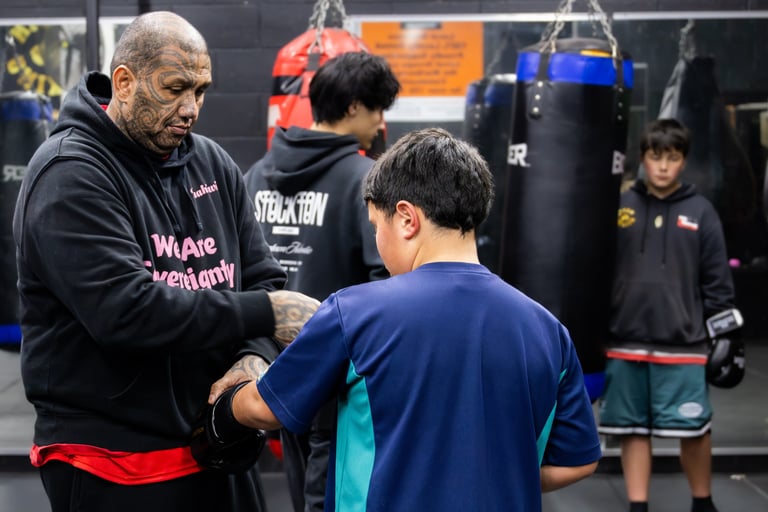
A few nights earlier I'd visited Box On Boxing.
Around 20 young people, aged from about eight to 17, filled the gym.
There were combinations to practise and fitness drills to complete, but that wasn't what struck me most.
Between rounds Lee was constantly moving, constantly watching - encouraging a kid who lacked confidence, helping a young boxer adjust their gloves, checking in with someone who seemed withdrawn or quiet.
The boxing almost seemed secondary.
"I didn't create this place to make world champions," he tells me.
"I created it to give people opportunities."
It's a simple sentence, but to understand why it matters so much, you have to go back to where Lee's own story began.
Around the same time, a mate introduced him to a boxing gym.
The coach he met there became much more than a trainer.
"He was like a father figure to me."
Boxing gave Lee discipline, purpose and a way to channel the anger he'd carried for so long.
"Boxing changed me. Saved my life. It helped me create who I am today."